Showing posts with label research. Show all posts

3/16/2018

Apply to Inspired Discoveries: Undergrad Symposium of Research & Creative Works

Apply now to present at the 9th annual Inspired Discoveries, a symposium of undergraduate research and creative works! One of Langsdale Library's missions is to recognize, encourage, and celebrate research and academic achievements.

Take this opportunity to share your hard work with the University of Baltimore community! Projects may include individual or collaborative research as well as creative works like video games or design projects. Presentations can take the form of
  • Poster sessions
  • Exhibits
  • Panel presentations
  • Presented papers
The best project in both areas will receive a $500 scholarship and their work will be submitted to UB's institutional repository.

Student applications are due by Friday, April 6th and must be accompanied by a faculty letter of recommendation. The event will be held on Friday, April 27th in the Learning Commons Town Hall.

Access the application and more information at the Inspired Discoveries website at http://langsdale.ubalt.edu/inspired-discoveries.


3/08/2018

Ditching the checklist: Evaluating information


Evaluating sources requires nuance, contextual understanding, and time to explore and validate the information. So, it’s not surprising a lot of us take shortcuts to determining what sources are credible. And shortcuts we take: See the just published study that found that humans (not bots) share fake information more often than true information.

Ryan McGeough and C. Kyle Rudick recently investigated reasons students gave in an introductory level communication course for selecting sources they used in a persuasive speech. They published their findings in a 2018 Communication Education article, “‘It was at the library; therefore it must be credible’: Mapping patterns of undergraduate heuristic decision-making” (also available freely through an author’s copy on ResearchGate).

While heuristic strategies help simplify the decision-making process (think: checklists), over-simplifying or heavily relying on one characteristic can lead to using inappropriate or unreliable sources.

McGeough and Rudick’s research found four main reasons college undergraduates gave for why they chose a source. 

1. Authority – perceived reputation of an organization or search tool (e.g. library database or Google Scholar)
A simplified way of using authority is to say that all material found through a reputable search tool will be credible, or that all articles published by a news organization or government agency are equally reliable. But, authority is constructed and contextual, so we need to consider the context of the sources, the different genres that are published by the same entity, and how we assign authority to a person or group. In other words, do the authors actually have authority in this particular context? Says who?

2. Form – the way information is presented
The study found that students believed if a source used statistics, it was deemed more credible, despite not researching to find where the statistics were coming from, or the methodology. Other students wanted a date and author for any source, and preferred sources in print. Form can definitely matter, but it’s important to acknowledge that information creation is a process, and different genres require different formats, delivery methods and publication methods.

3. Popularity – credible because it’s well known
Popularity led students to selecting a source because they’d heard of it before, and because the audience the students were presenting to would also be familiar with it, so they reasoned, more likely to buy in to their argument. But, popularity is problematic because it’s often the loudest and most traditional sources that are valued instead of underrepresented authors or formats, which can be just as, if not more, credible.

4. Ideology – fits our narrative or already held beliefs
Often we don’t see a bias until a source disagrees with us. As the authors put it, a student “conflated [their] ideology with ‘true’ or ‘neutral’ knowledge.” Instead of letting our questioning drive our research, and therefore allowing us to be more open to a wide variety of viewpoints, pre-determining our conclusion creates an artificial credibility level by which we judge sources. It’s dangerous because it eliminates good information that disagrees with us.
Which set of keys is the right one?

So where does this leave us? It moves us away from checklists to having some not-so-black-and-white conversations about how we evaluate information, and practicing good information literacy habits, so whether we’re retweeting or formally citing, we know what is credible.

All images from pixabay.com, Creative Commons License 0

2/12/2018

JHU Students Explore Langsdale's Special Collections on Baltimore 'Gayborhoods'


Langsdale’s Special Collections was recently featured in Johns Hopkins University HUB after their students took great advantage of the wealth of resources at home in UB’s Learning Commons: “Students sift through archives to uncover the history of Baltimore’s ‘gayborhoods’”.

Johns Hopkins students of the Intersession course “Gayborhood” Histories visited Langsdale’s archives to learn both the history of Baltimore’s “gayborhoods” and to learn how to work with archival resources.

Special Collections is the home to the Gay, Lesbian, Bisexual and Transgender Community Center of Baltimore and Central Maryland’s archives. The GLCCB is committed to “uniting and empowering sexual and gender minorities in Baltimore and Central Maryland and advocating for a better quality of life the entire community” (GLCCB). The center recently celebrated its 35th anniversary and is working with MICA on their LGBTQIA History Project.
This is the second time the course has been taught by JHU doctoral student Mo Speller. The class incorporates a breadth of unique experiences to expose students to the history of Baltimore’s gay community. These experiences include neighborhood tours, readings, short reflections, and an explorative group project.

Request an appointment with Special Collections today to explore the archives and learn about Baltimore’s ‘gayborhoods.’


1/30/2018

RED Talks: Research Engagement Day


RED Talks, Research Engagement Day, is next Tuesday and Langsdale can't wait to celebrate the research and creative works of UB's faculty and graduate students!

RED Talks is an opportunity for faculty and graduate students to share their research with the UB Community through highly-focused 5 minute presentations. The program is now available online so you can learn more about their presentations and pick and choose which you want to attend.

We encourage you to stay for all!

11/14/2017

Final Finish Strong


Final Finish Strong
                  Do you find yourself looking for a place to study late night on campus to get ready for finals?  Are you looking for a one stop shop where you can get academic support?  If you answered yes to either of these then Final Finish is the event for you!  Don’t be a procrastinator this semester, come to this event and let it be the jumpstart you need to start your finals preparation. 
            On Wednesday, November 29th Langsdale Library will stay open until 1:00am for the Final Finish event.  There will be writing consultants, tutors in many disciplines, academic coaches, and librarians to provide you with academic support as you prepare for your finals or final projects.  The event starts at 6:00pm which is when you can start dropping by to see any of the services listed above.   Writing consultants will be able to help you with all of your writing needs such as brainstorming, reviewing various drafts, help with structure, organization, punctuation, grammar, style, etc.  Be sure to bring any papers or outlines that you may need help with.  Tutors will be able to help you with content specific questions regarding your classes.  Be sure to bring your notes, textbooks, and any other class resources so that your tutor can best help you.  Academic coaches will be able to help you with time management techniques, studying strategies, setting goals, getting organized, etc.  Coaches can help you set your final exam and project study schedule so you will most likely to succeed.  The librarians will be able to assist you with your research needs.  They are knowledgeable about the databases and other resources available to UB students.
            If you are planning to attend this event it would be helpful to start thinking about what it is that you are trying to achieve with each service.  The more specific your questions are to the various service the better help you will receive, so help the consultants, tutors, coaches, and librarians help you by preparing before the event.  We hope to see you there!
                 

9/19/2017

Langsdale Lends a Hand with 'Rat Film' Research

Inspection by Health Department, courtesy of the CPHA Collection, via flickr
Next week, Langsdale Special Collections is hosting a colloquium where three fellows are going to give presentations on their research into structural inequality, sharing the information they unearthed in Special Collections over the summer. I say this not only to mention that it’s happening (September 28th at 4 p.m., Learning Commons Town Hall-- see you there!), but because whenever we’re promoting the fellowship, I have go-to collections I use to illustrate the concept, and The Citizens Planning and Housing Association (CPHA) records is one of the best to draw upon. Most of the digitized photos in the CPHA flickr album perfectly portray urban blight and how society has failed its most vulnerable citizens-- scenes of trash-strewn alleys, decaying structures, toppling fences, lean-to shacks, and children playing in the rubble circa the 1940s and ‘50s.  Contextually, many of these photos were taken during inspections by the Health Department, who were surveying the area’s cleanliness and overall habitability for its citizenry.

6/12/2017

Academic Support @ Langsdale

Langsdale Library and the ALC are open all summer long and we're here to support you through all your tough summer courses!


Working on a research project? Make an appointment with a Reference Librarian or drop by the reference desk on the fourth floor of Langsdale. We can help you organize your research project, plan your project, find credible sources, and more!

Need to start writing your research project and don't know where to start? The Writing Center can help you outline your writing project, organize your thoughts, and support a thesis or hypothesis. Consultants can meet with you at any stage of the writing process and review writing on any topic.

Taking a tough course this summer? We have one-on-one and group tutoring to review core course concepts and best meet your needs. Depending on the tutor, you can even meet in-person or online! Sign up using the online appointment system. If you don't see your course listed, let us know!

If you're struggling with a computer program, we're here to support you with that too! Not sure how to change your Running head in Microsoft Word? Scheduled for a design course in the fall and need to brush up on your Adobe InDesign/ Illustrator/ Photoshop? Need to make convert a file to a PDF? Not sure how to navigate Sakai? Sign up for an appointment on the Computer Application Skills schedule and we'll get your questions answered!

Research, writing, course, and computer skills support appointments can all be made using the online appointment system. We look forward to working with you!

6/01/2017

Credo: New Database @ Langsdale

http://proxy-ub.researchport.umd.edu/login?url=http://search.credoreference.com


Check out the new materials at Langsdale! We've recently added Credo Reference to our list of databases. Credo covers all of higher education's primary disciplines, with over 650 titles to search. It includes publications like encyclopedias, atlases, dictionaries, and reference books.

Credo also offers over 1000 videos, almost 300,000 high-resolution art images, plus thousands of other images from all subjects. Another unique feature offered by Credo allows you to create a visual mind map, which can help you brainstorm and plan your research projects.

The database, Credo Reference, can be accessed through the Databases guide on Langsdale's web site. Visit here
 to get tips and additional information on how to search Credo.

1/26/2017

Try Out Oxford University Press

Oxford University Press is at Langsdale for a limited time!


Langsdale is hosting trials for four Oxford University Press resources up until February 16. You can find them here, as well as on our Databases page. Check out the right hand column to see what's new or available for a limited time.

At Oxford Reference Online, you can find some of Oxford University Press' most well-known and visited titles from their Encyclopedias and Companions and from selected partner publishers' scholarly works.

Oxford African American Studies Center is the most comprehensive collection of over 10,000 scholarly articles that focus on the lives and events that shaped African American and African history and culture.

Oxford Bibliographies Online provides accurate and reliable resources on a variety of academic topics, written by academic experts, that guide faculty and students through the current scholarship.

Social Explorer is a demographic data visualization and research website that engages the public with society and science through dynamic maps and customizable reports.

Check out these resources while they're available at Langsdale and let a librarian know what you think!

11/10/2016

APA Style Central Tutorials


Business, Psych, Criminal Justice, or any other APA major?

Don’t miss this opportunity to demo APA Style CENTRAL for free during the month of November. The ALC will be hosting a walk-in clinic for students and faculty to explore the program on Wednesday, Nov. 16 from 12 to 5:30 p.m. Langsdale has the official program for a 30 day trial and if you use APA, we want you to test yourself to improve your research and organizational skills.

The program operates around four centers: learning, writing, research, and publishing. Students are able to organize their research and writing in one central online location. Its word processor allows you to use several APA approved templates. It helps manage and create your reference sheet and citations. It can even search the APA PsychINFO database for citations.


The trial is only for 30 days, so don’t miss this opportunity to experience APA to the fullest.

6/24/2016

Welcoming the Fellows, Part 1: Caitlin Rathe

Caitlin sizes up the scene

When Caitlin Rathe, a student at University of California Santa Barbara, jetted into chilly Baltimore from the sunny Left Coast last February, she wasn’t entirely sure she was going to find what she was searching for. Rathe is a doctoral student in history, who has been focused on the story of welfare and how it changed in the United States during the late 20th century. She narrowed her focus on 1970s and 1980s-era food assistance in order to make the topic more manageable. Conversely, that’s when things got tricky.

3/31/2014

The Power of Public Archives

Photo credit: Xpressive4ever Dance Inc

There is something very powerful about public archives when they are used by citizens to improve conditions for the next generation.

That's exactly what Angela Koukoui and her colleagues are doing at Langsdale Library. Angela is using archival material from Langsdale's Special Collections Department to advocate for arts funding in Baltimore public schools. Her relationship to this topic is in no way theoretical. Now the founder and artistic director of a local nonprofit for city youth, Angela grew up in East Baltimore in the 1980s, where she trained as a dancer through the city's Cultural Arts Program and went on to study dance at The Baltimore School for the Arts.

According to Ms. Koukoui, "I didn’t go looking for the arts, the arts found me in my own Baltimore City community and embraced me with gifts of opportunities that I never thought I could obtain."

What drew Angela to Lansdale Library was the rich visual history of the Cultural Arts Program (CAP) documented by the photographer Robert "Breck" Chapman and held in special collections. CAP's origins trace back to the War on Poverty's Model Cities Program and the grassroots efforts of parents at Baltimore's Dunbar High School. The CAP program was the cultural education arm of city services that were delivered to residents through a network of neighborhood centers. In the 1970s and 80s, these programs were conducted through the municipal Urban Services Agency. One of these citywide centers (known as Gallery 409, and later, the Eubie Blake Center) became the performing and visuals arts hub of CAP. When CAP was eliminated from city government in the 1990s, the Eubie Blake Center transitioned to nonprofit status.

In addition to the archival material Angela is using to research the history of Cultural Arts, she's also conducting interviews with key community leaders, arts instructors, and politicians to further her advocacy efforts. This work is being done to support the Governor's Leadership Council Task Force on the Arts. "Because of the great gifts instilled in me through the arts, I’ve had the honor to give back to the community that once gave back to me."

To learn more about Angela's work, please visit the Xpressive4ever Dance Inc. Facebook page.

1/13/2014

Academic Syncopation

Breaks in the academic calendar are important in Special Collections because they allow time for in-depth research. It's common for faculty and graduate students to take advantage of their time outside the classroom to develop theses, dissertations, peer reviewed articles, and books that require archival sources. Here in Special Collections, we look forward to summer and winter sessions as times when dedicated scholars will be diligently working away in the archives! Researchers often travel from other colleges and universities during January and August, scheduling trips at multiple archives along the way. Special Collections takes pride in facilitating the research of scholars from our global academic community. Do you have research that would benefit from archival sources? If so, now's a great time to explore our collections and schedule time in our research room!


11/26/2013

Research the History of Your House: A Guide from Baltimore Heritage

Read about the history of the Poe statue
Baltimore Heritage, Inc. is a nonprofit organization that works in a variety of ways to preserve and bring awareness to the many historic buildings and neighborhoods in Baltimore. They've built an excellent mapping tool for viewing details of some of Baltimore's historic gems.

One of the resources available through their website is a fantastic research guide called "How to Research the History of Your House or Neighborhood." The guide divides the search into phases ("Where do I start?") or you can search for a particular business, architect, or theme. Going further, it explains where and how to find maps and pictures.

The full link to the guide is: www.baltimoreheritage.org/resources/research-guide. I recommend you check it out!

4/29/2013

The Research Paper that Grew Legs and Destroyed Cities

There really are only a few things that I believe myself truly, unabashedly, and unapologetically good at. And right at the top of that short list is procrastination. It's a gift, I don't mind saying. Since college, though, I've learned to temper said gift to some small degree. I set schedules with alarms that blare annoying, piercing sounds, or program them to play some song that I utterly despise (at the moment it's "You Give Love a Bad Name" by Bon Jovi; I started this because I used to set my clock radio to NPR and then just lie in bed on the weekends listening to the news or Wait, Wait Don't Tell Me, sometimes for hours when I should have been at work). At times, I lock myself in my office through the early morning hours, and periodically on the weekends. I set my phone to vibrate and make sure to leave it on a different floor of the house so as not to be distracted by friends calling and luring me to this oh-so-cool thing that I already knew about and hadn't had the slightest inclination to join, but now that I am about to sit down and work, well, that sounds like a great idea. That last one might have more to do with with nerves or anxiety, than procrastination (the effect is the same though). After all, you can't fail at something that you haven't started. But boy, when I was in college did I truly have a penchant to procrastination. I once wrote an 8-page paper given to me at the beginning of the semester an hour before class. I don't remember the grade I got on that one, but I do remember walking to class reading it and turning red over the many, many typos and terrible constructions contained therein.

I know I'm not alone in this fact. If I were to take a poll of undergraduate students and ask, "How long does it take you to start an assignment with a deadline a month away?" I'm pretty sure I'd get a response of at least 75% answering three weeks. But that is slight consolation. The great men and women of arts and letters and science, what did they do? How did they circumvent the universal desire to watch a half-a-day's worth of infomercial GIFs? Well, as it turns out, they may not have had the fortitude and robotic determination that you may have thought.

So, for this time of year when many of you are beginning to have nightmares of unfinished term papers growing legs and a lust for destroying cities, I figured I'd give you some advice, and show that there is some hope.Well, maybe I shouldn't be the one to give you advice (see everything above). Maybe I'll let someone with credentials and accomplishments speak for me. Here is a link to a series on how many artists and writers and scientists got done all the great work that they did.

Hope that helps.

4/24/2013

Churnalism: Holding Journalists Accountable

I love deadlines. I love the whooshing sound they make as they go by.
Douglas Adams
by flicker user anniemole
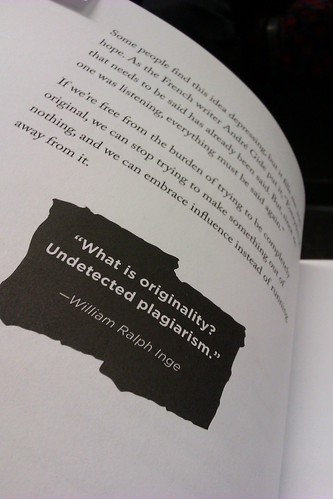
When it comes to writing, we all have to face down deadlines. Whether it's a student working on a term paper, a librarian trying to come up with a blog post, or a journalist covering a breaking story. And, all too often we are all tempted to copy and paste just a line or two from someone else.

Well, things may have just gotten a little tougher for journalists in the US seeking to take a shortcut. The Sunlight Foundation, a non-profit organization who's mission is to make government more transparent, has partnered with Media Standards Trust, from the UK, to release Churnalism US.

The service, delivered as a website or browser extension, checks articles against other published works to see if text has been lifted from somewhere else. Based on an open source search platform, Churnalism compares the submitted text against a selection of sites that publish government and corporate press releases. It then displays the results side-by-side, highlighting and linking suspicious text blocks.

Besides being a tool to catch plagiarism from deadline-crunched journalists, Churnalism can also serve to detect those who are purposefully misrepresenting their subjects. Sometimes authors with a particular agenda will selectively quote their subjects in order to make a story more juicy or to try and influence their readers. In its side-by-side comparison mode, Churnalism can make it easier to spot such selective quoting.

Check it out, catching deceptive journalists has never been so fun!

4/22/2013

Free to All

On Thursday, April 18, 2013 the Digital Public Library of America (DPLA) was launched without much fanfare. Actually, there was supposed to be much fanfare—at a public event at the Boston Public Library—but given the bombing that happened just outside the BPL a few days earlier, the event was postponed.

According to its website, “the DPLA brings together the riches of America’s libraries, archives, and museums, and makes them freely available to the world. It strives to contain the full breadth of human expression, from the written word, to works of art and culture, to records of America’s heritage, to the efforts and data of science.”  

What makes this particularly exciting is that through the use of metadata these millions of items can be accessed and connected in new ways for the creation of new resources and new knowledge. And those conversant with programming can contribute by building applications or discovery tools.

DPLA is free, it’s online, it’s for everyone, and “it offers a single point of access to millions of items—photographs, manuscripts, books, sounds, moving images, and more—from libraries, archives, and museums around the United States.” So stop reading this blog and start exploring at DPLA!

3/12/2013

iPhone Apps and Library Books

O. Von Corven "The Great Library of Alexandria

Last week I got an iPhone, my first. As you could probably guess, I've spent the past few days both trying to figure the thing out and browsing the insane amounts of everything on offer in the App Store. It turns out there are way more programs, games, and knickknacks of all kinds than I could have cared to imagine. Even when picking out what I thought would be a simple app, like a dictionary, there was more to choose from than I bothered to look at, probably in the hundreds. With this kind of selection it’s difficult not to think that I’ve picked the wrong one. Maybe there was a faster one. A more attractive one. One with more terms, or easier to understand definitions. One with a more complete etymology. One with pictures. One without advertisements. One that translates to the Spanish. One that translates to the Bantu. One that will read the pronunciation in a robot voice. One that will read the pronunciation in a celebrity voice. One that will read the pronunciation as a robot doing an impression of a celebrity voice. Etc. etc.

In the grand scheme of things, deciding what dictionary app to use is a pretty trivial decision. It isn’t something that I walk around regretting or even pondering as I’m in line grabbing a sandwich at Soup’s On. But I have noticed that I do, when I use the app, wonder if maybe I should go back and see if one of the others is more suited to my needs (whatever they are). Maybe it (that perfect-yet-ill-defined dictionary app) would make my life easier and me happier.

3/30/2012

Need help researching for end of the year papers?

Albert Einstein
akg-images / Universal Images Group

Spring Break has come and gone. The countdown of the last 6 weeks begins now. It’s time to begin thinking about those final papers and projects that will be due soon. Research is usually an enormous portion of final papers and projects. Langsdale has resources to make things just a little bit easier for you. I will start with my personal favorite:

Databases: Need credible sources and reliable information? Langsdale’s databases are the best place to start. There are databases for every subject and major. You will be sure to get useful information

LibGuides: LibGuides is a research assistance tool, with subject guides and useful resources compiled by your friendly librarians. Find out what they know by searching through the LibGuides!

Easybib citation help: It’s a simple way to create citations. Citing properly is not always an easy task when you aren’t familiar with the format. Easybib allows you to copy and paste a website, book, Newspaper, Journal, or database. After you gather the information it correctly creates a citation which you can then print or turn into a Word document. This saves you time and ensures that you’re citing your sources accurately (though remember, it is always a good idea to double check the formatting just to make sure that everything is in its right place).

And of course we have a huge selection of books and ebooks to help you with any project.

You can always ask a librarian for help! There are several ways to get in touch with library staff, such as chat, telephone, e-mail, or just stop by.


As you can see we’re here to make these last few weeks stress free!

And as a side note to graduate students, remember you can submit your theses and dissertations to Special Collections and have them bound at a low cost.