Showing posts with label video. Show all posts

12/05/2017

First Television Station in Baltimore


In 1956, 2” Quad became the first videotape format with commercial success. From that point until the late 1970s, this video format was used to record the vast majority of broadcast television. The playback equipment needed to view 2” Quad tape is extremely expensive to purchase and maintain which makes accessing the analog video signals recorded in this format very difficult. The only effective way to provide access to these unique moving images and recorded sounds is to digitize them.
 
 
The Special Collections Department at the University of Baltimore’s Langsdale Library recently reformatted a part of the local Baltimore television collection, WMAR-TV Collection. The content was stored in its original inaccessible form of 2” Quadruplex open reel videotape (2” Quad), which is the most unstable video format.
 
Local television stations, such as Baltimore’s WMAR, are continuing to cover both regional and national news stories and events. TV came to Baltimore during the post-World War II bang. WMAR-TV was the first television station in Baltimore and one of the first TV stations in America, going on air on October 30, 1947. WMAR is one of the three major Baltimore television stations, which have survived, providing a significant historical video documentation of the region and nation from a Baltimore viewpoint. There are several mentions of national political figures in the 2” Quad from WMAR-TV, such as President Eisenhower, dating from 1965-1969, including “Eisenhower Obituary”, as well as Spiro Agnew, 55th Governor of Maryland and 39th Vice President of the United States who resigned after corruption charges. These tapes date from 1968 to 1973. There are several other notable topics in this collection including: the Preakness (1974), “1984 in Maryland: A Birthday Celebration”, and “Sights and Sounds Baltimore City Fair” (1983).
 
If you would like to find out more about what is available in our WMAR-TV Collection, you can browse the complete database here.

“1984 in Maryland: A Birthday Celebration”


6/14/2017

Be Kind, Rewind: Putting Endangered Collections First

Quad Tape, soon to appear at a nonprofit regional archive near you.
Tick-tock! Time is running out for videophiles to enjoy the glitchy, retro pleasures of analog media. Last year, the last videocassette recorder (VCR) was manufactured in Japan, and preservation experts recommend migrating VHS and other types of analog video to digital formats within 10 to 12 years. Langsdale Special Collections has been caring for two major audiovisual news morgues: the WMAR collection and the WJZ collection, which both consist of raw footage and broadcast materials from the two local network-affiliated television stations. 

5/15/2015

The Soul of Baltimore

As mentioned in a previous blog post, the WJZ-TV and WMAR-TV Collections at the Langsdale Library hold approximately three hundred 2-inch Quad reels that are in need of digitization to preserve their unique audiovisual content. One of these reels was digitized recently and uploaded to the Internet Archive. It read on its original label ,“Master: SOUL OF BALTIMORE 27:51”. The term “master” indicates that this is the highest quality version of this content. 

After researching historical newspaper databases, this title was found to potentially be a 1968 WMAR-produced special entitled, “The Soul of Baltimore”. This seemed like a great candidate to digitize as it was about the history of Baltimore’s Pennsylvania Avenue, the center of the city's African American community in the first half of the twentieth century. The special is also narrated by Walter P. Carter, civil rights activist and chairman of the local chapter of the Congress of Racial Equality (CORE). After digitization, the content on the video reel was found to match the content on the label, as well as having ten minutes at the end of the reel that had not been recorded over or erased. These “extras” included 1960s era broadcast footage of two other WMAR-produced shows, a few commercials, and a few minutes of a nationally syndicated show, “Truth or Consequences”.

"The Soul of Baltimore" is especially powerful to watch in light of the recent uprising and protests surrounding the death of Sandtown-Winchester resident Freddie Gray, as many of these events transpired on or near Pennsylvania Avenue. You can watch the entirety of "The Soul of Baltimore" below.


4/17/2015

Ewww-Matic

Between our WMAR-TV and WJZ-TV Collections, there are about 10,000 U-matic tapes with unique local television content that need to be digitized for preservation--we have started to slowly go through these tapes, starting with the oldest tapes from 1977 and those that are requested by researchers.

In the last few days in Special Collections we have been dealing with some sticky issues with some U-matics that a researcher needs to view. In December of 1982, it seems that WJZ started to use a different, cheaper brand of U-matic. This specific brand is extremely problematic for audiovisual archiving now: the splices that hold the tape to the plastic hubs need fixing for almost every tape, many of the inner workings of the cassette are made of cheap plastic that breaks easily, and the glue that is holding some of these components together has started to seep out, leaving a gooey, sticky substance over certain parts of the tape that can damage the tape and the playback deck.

Our intern Massimo Petrozzi will be spending the day opening up these cassettes and cleaning the glue residue before the tapes are put into the playback deck. Check out our step-by-step guide on how to open a U-matic tape, and most importantly, how to put the tape back together again.

With a lot of hard work and patience, these tapes will eventually be digitized and available online, like this successful U-matic transfer:

3/26/2015

The Granddaddy of Video


The silver reel you see on your right is an example of the first videotape format ever released into the world (as compared to the size of a standard VHS videocassette tape on the left). The name of this format is 2-inch Quadruplex, also known simply as "Quad". The "2-inch" refers to the size of the width of the tape (please see below the open reel brown 2-inch-wide Quad tape versus the 1/2-inch VHS tape encased in a plastic shell, respectively).


CBS was the first on-air user of the 2” Quad machine, to tape-delay the evening CBS News broadcast with Douglas Edwards on Nov. 30, 1956. From that point until the late 1970s, the vast majority of broadcast television was recorded onto this video format.  

In the WJZ-TV and WMAR-TV Collections at the Langsdale Library Special Collections Department, we hold approximately three hundred 2-inch Quad reels from these local television stations. Highlights from the labels suggest that they are masters of several local television broadcasts and even national broadcast news ranging in date from the early 1960s to the early 1980s. However, we can't be entirely sure of the content until the tapes are digitized--an expensive endeavor due to the professional expertise, time, and obsolete equipment needed. According to an estimate by the Library of Congress' National Recording Preservation Plan, by approximately 2027 these tapes will no longer be physically able to even undergo digitization! Contact specialcollections@ubalt.edu for more information.

2/05/2015

Finding AV in Special Collections


There have been a few blog posts written before about the WMAR-TV and WJZ-TV Collections, but today I would like to discuss the process of actually finding and accessing an AV item that is requested.

First, how might researchers even know where to look for WMAR, WJZ or Baltimore-area news footage? They would most likely conduct a Google search which would show (a few hits down in the results) the Langdale Library Special Collections’ website. We also have a collection-level entry in ourlibrary catalog that will show as a result in searching WorldCat.org. This points to collection-level finding aids, which then points to that particular collection on the Special Collections’ website.

Our website has inventories online that describes many item-level objects for these two collections--although not everything that we have is mentioned online. For the WMAR-TV Series I film reels, we inherited old paper-filled log books where most of the films are described with key subjects and terms, chronologically. Large portions of these have been electronically transcribed and are in word-searchable HTML tables that are also searched by Google (here is an example of one). For the rest of the collection, the logs are either not online or scanned but not searchable (and in cursive, which many people these days cannot read). The WJZ-TV inventory is a list of the titles on the videocassettes containers in word-searchable PDFs—just CTRL-F and type in the term you are looking for.

Binders full of films: the WMAR-TV Collection Log Books
Once you know what you want, we have a location register in Excel for me to easily find the boxes in our storage areas. The film reels take a bit more time to find as their locations are not in the register: they are not stored in boxes so they need to be entered into the Excel at the item-level and there are about 4,000 of these reels (we are slowly working on this, but, like many libraries and archives, we have limited time and resources).

After I physically find the item, if it is a Umatic, VHS, or Betacam tape, I then can make a digitized copy for you pending some restrictions. However if it is any other AV format it must be sent out to a vendor at cost to the patron. If it is one of our 4,000 16mm films, I can only send a photo of a pertinent frame for whatever subject you are looking for. We cannot project the film as this will irreparably damage the film and as archivists we are bound to “do no harm” to our collections. 

Recent film frame sent to a patron: Eubie Blake playing the piano in 1973.
If you see the photo I send to you and absolutely must have a digitized copy of the film, you must pay to have it sent to a professional preservation vendor to have the whole reel or video digitized (we must approve of the vendor as there are many qualifications they must meet). We initially provide 1 hour of work for free (please read more about our services here). These charges help us to maintain our expensive obsolete AV equipment, purchase preservation supplies and containers, and to overall better care for and provide access to these collections.


As tapes and films are digitized, we take any information we can find about that item and upload them to the InternetArchive collection for viewing and downloading for non-commercial purposes. There are several hours uploaded per week of unique Baltimore-area history, so please stay tuned for more!

7/21/2014

Space, Size, and Videotapes

The Langsdale Library Special Collections Department has finished our move from the library's previous building to our current location in the University of Baltimore’s Learning Commons. We were scheduled after the rest of the library and took over twice as long. This was due to the vastness of our collections: we have thousands of boxes of unique, historical primary sources that we care for and provide access to.

After the move we have about 40% less physical space. While we have been able to weed a few items and boxes here and there, the collections are extremely cramped. The majority of the collections that I manage consist of videocassette tapes: the WJZ collection itself has over 20,000 videos! Now that I have a video reformatting station set up (not fully operational yet), I can begin transferring the content from these tapes to digital files. This needs to begin as soon as possible as videotape does not have a long life expectancy. In fact, it may already be too late to digitize some of the older and more problematic tapes. 

8/22/2013

Digital Video - at Langsdale and from the White House

I've been thinking a lot about digital video the last few days. My new graduate assistant, Antoinette Woods, will be starting work at Langsdale next week, and her job will be to create short, original videos for the library. These will range from six-second Vines to longer tutorials and video tours on YouTube or Vimeo.

I've also been talking to our archivists, Ben Blake and Aiden Faust, about some of the interesting things they are doing with our historical news footage collections. We've also started planning the hardware and software that the library will need to acquire for the new audio/visual archivist position they are looking to fill.

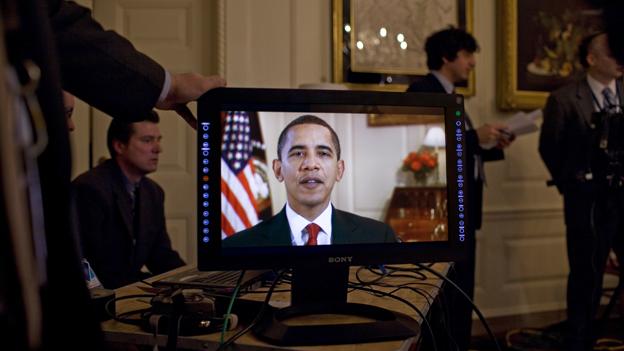
President Obama on a video screen
Photo: Pete Souza
So with all of this fresh in mind, I was very interested to hear a piece on WYPR this morning on the future challenges to organize the "thousands and thousands of hours" of footage the first White House videographer, Arun Chaudhary, has amassed since President Obama took office. I was also please to hear a historian at our affiliate school Towson quoted on the topic. It's always nice to hear from local experts on national programs, even if they aren't from UB.

This got me thinking: Massaging all these videos into a coherent collection that can be meaningfully used by researchers will require a lot of hands from a lot of disciplines. From metadata experts describing the content, to web programmers designing the UI, to historians putting it in context with the more official videos. So -- current UB history majors and design students interested in digital video -- now's your chance to start thinking about these kinds of projects. Get some real world experience working with digital video here or other archives in Baltimore, and solve the problems these types of resources bring with them.

It would be great to hear from one of you on NPR someday talking about how you helped make all this historical, behind the scenes, footage easily available to the world.